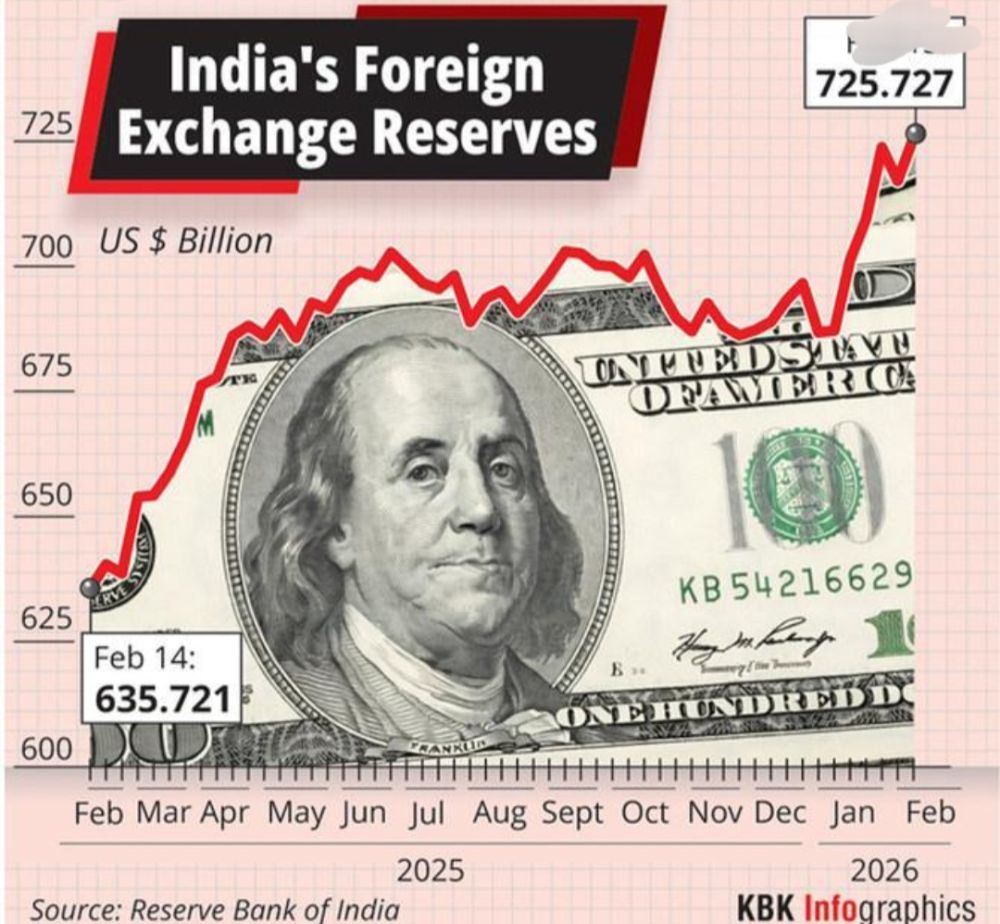
NEW DELHI: India’s foreign exchange reserves have surged to a record $785.71 billion, but the rupee is still struggling to gain meaningful strength against the US dollar. The sharp rise in reserves has raised a key question in financial markets: If India has more dollars than ever, why is the rupee still hovering around ₹95.7–₹96 to the dollar?
According to the Reserve Bank of India, forex reserves jumped by a massive $44.9 billion in a single week, the biggest weekly increase on record. A major factor behind the surge was the RBI’s dollar-swap measures and foreign currency inflows, including those linked to the FCNR(B) scheme. But the increase in reserves does not automatically mean the same volume of dollars is available for immediate sale in the open market.
Record Reserves, But No Automatic Rupee Boost
The dollars raised through FCNR(B)-related arrangements were largely absorbed into the RBI’s reserves rather than simply flooding the spot market. Banks swapped foreign currency with the RBI, increasing the central bank’s reserve stockpile. As a result, the headline reserve number rose sharply, but the immediate supply of dollars available to support the rupee did not rise by the same amount.
The RBI has previously used its reserves to smooth excessive volatility in the currency market. During periods of elevated oil prices and geopolitical uncertainty, heavy dollar sales reduced India’s reserves significantly. Yet the rupee continued to face pressure, showing that foreign exchange intervention can slow a fall but cannot permanently reverse the underlying forces driving the currency.
Trade Deficit Adds More Pressure
India’s large merchandise trade deficit remains another major challenge. The deficit stood at around $30.4 billion in June and widened to nearly $32 billion in July, before easing to about $26.86 billion in August as exports improved.
A large trade deficit means India needs more foreign currency to pay for imports than it earns through merchandise exports. That creates sustained demand for dollars and can put pressure on the rupee.
Foreign Investors Pull Out Billions Foreign
US Rates, Dollar Demand Become Another Headache
The global strength of the US dollar is also working against the rupee. Higher US Treasury yields can make dollar-denominated assets more attractive to global investors, particularly when the additional currency risk of emerging markets is taken into account. The interest-rate gap between India and the US has also narrowed. If investors can earn relatively attractive returns in US dollar assets, some may become less willing to take additional currency risk by investing in emerging markets. investor selling is adding another layer of pressure.
Foreign portfolio investors have withdrawn billions of dollars from Indian equities during 2026. Although there was some renewed buying during July and August, selling pressure returned amid heightened global and geopolitical uncertainty. In the first two weeks of September alone, foreign investors reportedly pulled out around ₹13,138 crore from Indian equities. Total FPI withdrawals during 2026 have crossed the previous year’s full-year figure, increasing pressure on domestic financial markets and the rupee.
CRUDE OIL: The Biggest Threat to the Rupee?
For India, crude oil remains a critical vulnerability. The country imports around 85% of its crude oil requirements, meaning every major rise in global oil prices increases the import bill and demand for dollars. With Brent crude moving above $109 a barrel, the pressure on India’s external balance has intensified. Expensive oil can hit the rupee through two channels: it increases the dollar requirement for imports and can also unsettle investors worried about inflation, growth and India’s current-account position. The possibility of additional US measures affecting Russian oil imports adds another layer of uncertainty for India’s energy bill and external finances.
RBI Has Reserves—But No Fixed Rupee Target
The RBI’s objective is not to defend a particular rupee-dollar exchange rate indefinitely. Its stated approach is to contain excessive volatility and maintain rderly conditions in the foreign exchange market. That means the central bank can deploy its massive reserves when necessary to smooth disorderly market movements, but reserves alone cannot determine the long-term value of the rupee.
Crude oil prices, the merchandise trade deficit, foreign capital flows, US interest rates, Treasury yields and global dollar demand will continue to shape the rupee’s trajectory. The RBI may have a massive reserve cushion—but the forces pushing the rupee remain very much alive.














Comments
Sign in with Google to comment.